Drone aerial broadcast seeding of cover crops into standing corn, soybeans and specialty crops across the Corn Belt, Chesapeake Bay watershed and California.
Aerial Cover Crop Seeding drone services in North Dakota are listed by 4 operators in this directory. North Dakota's state-level custom-rate guidance averages $12 to $17/acre, with the broader aerial cover crop seeding band running $12 to $18/acre. In North Dakota, aerial cover crop seeding most commonly serves wheat, corn and soybeans. North Dakota sits in the Great Plains region, which shapes the calendar, weather and competitive pressure local operators plan around. Commercial drone applications in North Dakota require Unmanned Aerial Applicator License (separate from manned aerial) from ND Aeronautics Commission + NDSU Extension on top of FAA Part 137 certification.
Aerial Cover Crop Seeding โ quick facts
Drone cover crop seeding costs $12 to $18 per acre application only, or $22 to $35 per acre seed and application combined. USDA NRCS EQIP cost-share under Cover Crop Practice Standard 340 pays $25 to $55 per acre in most states, reducing net farmer cost to $5 to $12 per acre. A single DJI Agras T50 broadcasts 200 to 400 acres per day during the peak August to October window.
๐ฑ
How aerial cover crop seeding works
Aerial cover crop seeding is the fastest-growing ag drone service in the US, with approximately 15 million acres planted to cover crops annually. Drones broadcast cereal rye, annual ryegrass, crimson clover, hairy vetch, oats and brassicas into standing row crops 2 to 6 weeks before harvest, giving seeds a 3 to 4 week head start over post-harvest ground seeding. The USDA NRCS Cover Crop Practice Standard 340 makes drone seeding eligible for EQIP cost-share payments of $25 to $55 per acre in most states, which often covers 50 to 70 percent of the total cost. Throughput on a DJI Agras T50 or T40 runs 200 to 400 acres per drone per day of broadcast seeding, with seed rate, wind conditions and field layout as the main variables. Most operators handle the seed procurement themselves and charge a combined seed-plus-application rate, though bring-your-own-seed arrangements are common for farmers enrolled in state cost-share programs with specific species mandates.
Typical rate: $12 to $18/acre
Aerial Cover Crop Seeding on top North Dakota crops
In North Dakota, aerial cover crop seeding is most commonly used on:
Prices reflect 2026 industry-typical drone spraying rates by crop. Pair with the operator-stated rates below for a quote tailored to your fields.
Aerial pesticide licensing in North Dakota
North Dakota requires Unmanned Aerial Applicator License (separate from manned aerial) for aerial pesticide application. The licensing authority is ND Aeronautics Commission + NDSU Extension.
Great Plains Drone Co. operates an NDAA-compliant fleet of Hylio AG-272 drones across Nebraska, South Dakota and Kansas. We serve large-scale grain producers with corn and wheat fungicide applications, and offer fall cover crop seeding programs across the northern Plains. Minimum booking: 40 acres. No travel charge within 100 miles.
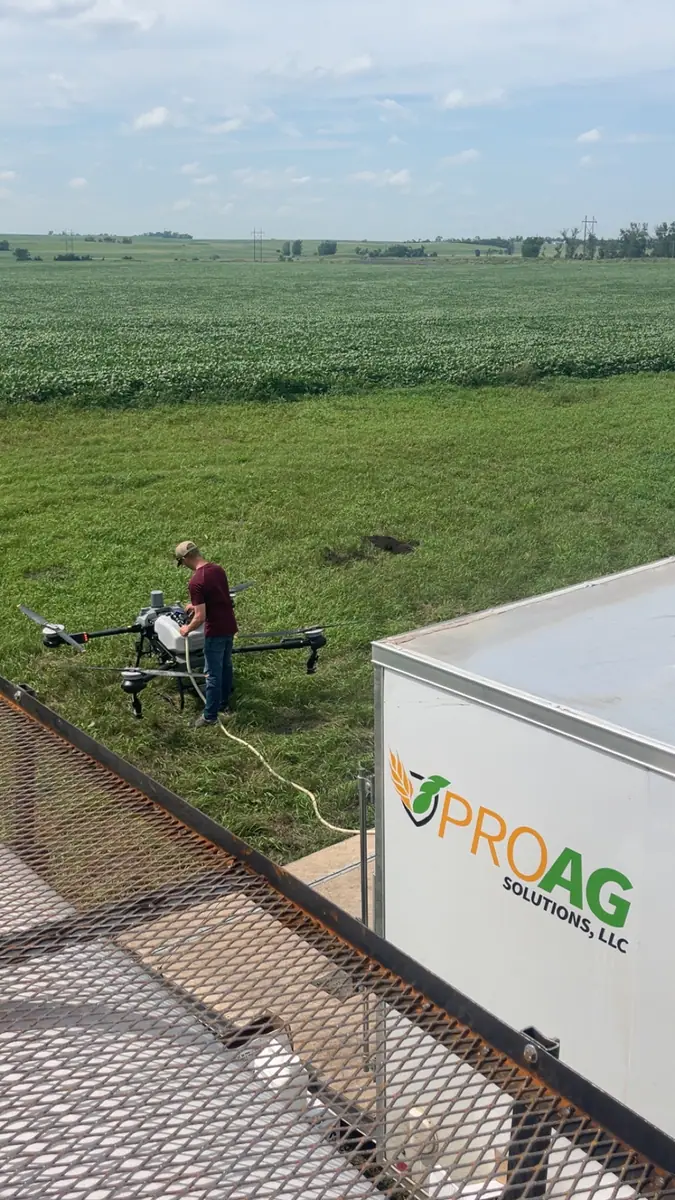
Pro Ag Solutions was founded in 2021 by Cory Palm. Cory has an Associates Degree in Ag Aviation, then worked as an Agronomist for 20 years before stepping back into aerial application using drones. Starting with just a trailer and a DJI T30, Pro Ag Solutions has grown into a full fleet of drones and support vehicles. Licensed in ND, MN, SD. Services include row crop spraying, pasture spraying, CRP, aquatic and right-of-way spraying, multispectral imaging and mapping, soil sampling, cover crop spreading, seed spreading and fertilizer spreading. Team of 6 Part 107 pilots and 4 ground operations personnel.
Verified OperatorFAA Part 137 โ
Drone SprayingFertilizer ApplicationCover Crop Seeding+3 more
4 operators in our directory list aerial cover crop seeding as a service in North Dakota. Use the operator grid below to compare credentials, fleet, response time and pricing before reaching out.
Commercial aerial cover crop seeding in North Dakota requires three credentials: an FAA Part 107 Remote Pilot Certificate for the pilot, an FAA Part 137 Agricultural Aircraft Operator Certificate for the business, and Unmanned Aerial Applicator License (separate from manned aerial) from ND Aeronautics Commission + NDSU Extension. Confirm any operator you hire holds all three before any application.
Most North Dakota operators book 4 to 6 weeks ahead of peak windows; rate confirmation is contract-bound and operator-specific. In North Dakota, aerial cover crop seeding is most often booked for wheat, corn and soybeans, each with its own seasonal window. For one-off jobs during peak demand spikes, supply tightens fast โ establishing the operator relationship in the off-season pays off.
Cereal rye is the workhorse in the Corn Belt and establishes reliably from September aerial seeding. Annual ryegrass, crimson clover, hairy vetch, oats, radishes and brassicas all broadcast well. Large-seeded crops like soybeans and peas are impractical because of tank capacity and seed damage on impact.
Late August through early October in the Corn Belt, timed around corn canopy senescence so seed reaches soil. Iowa and Illinois operators typically run August 20 through September 15 for corn. The goal is for corn leaves to drop within a week of seeding so sunlight reaches germinating cover crops.
EQIP cost-share under Practice Standard 340 varies by state but typically pays $25 to $55 per acre for seed plus application combined, which covers 50 to 70 percent of the total drone-seeded cost. Some states layer Regional Conservation Partnership Program (RCPP) funds on top for 80 to 100 percent coverage. Check with your local NRCS field office for state-specific rates.
For early establishment, yes. Drone seeding into standing corn or soybeans gives the cover crop 3 to 4 extra weeks to root before frost. This is critical for cereal rye aiming at full ground cover by November, or for clovers that need time to nodulate before dormancy. Post-harvest drilling after late October corn harvest often produces thinner stands.
By late July or early August for September slots in the Corn Belt. The cover crop window overlaps with corn fungicide mop-up and soybean pre-harvest, so operator capacity is the real constraint. Late callers usually get pushed into post-harvest ground seeding at higher combined cost.