In-season drone crop scouting with NDVI, NDRE and multispectral imagery to detect stress, disease and pest pressure before visual symptoms appear.
Crop Health Monitoring drone services in North Dakota are listed by 3 operators in this directory. North Dakota's state-level custom-rate guidance averages $12 to $17/acre, with the broader crop health monitoring band running $3 to $10/acre per acre per flight. In North Dakota, crop health monitoring most commonly serves wheat, corn and soybeans. North Dakota sits in the Great Plains region, which shapes the calendar, weather and competitive pressure local operators plan around. Commercial drone applications in North Dakota require Unmanned Aerial Applicator License (separate from manned aerial) from ND Aeronautics Commission + NDSU Extension on top of FAA Part 137 certification.
Crop Health Monitoring โ quick facts
Drone crop health monitoring costs $3 to $10 per acre per flight, or $25 to $60 per acre per season for weekly monitoring programs. Multispectral sensors detect nitrogen stress, disease and pest damage 7 to 14 days before visual symptoms appear. Only FAA Part 107 is required, and the service is commonly bundled with variable-rate prescription mapping for input savings of $8 to $15 per acre on nitrogen and fungicide.
๐ก
How crop health monitoring works
Drone crop health monitoring uses multispectral and thermal sensors to detect plant stress 7 to 14 days before visual symptoms appear to a scout on the ground. Operators fly the DJI Mavic 3 Multispectral, Phantom 4 Multispectral or Parrot Bluegrass Fields platforms over corn, soybeans, wheat, vegetable and specialty crop fields on a weekly or biweekly schedule. Deliverables include NDVI and NDRE vegetation index maps, thermal imagery for irrigation stress detection and zone-based reports that translate spectral data into specific scouting recommendations. Typical use cases include tracking corn rootworm damage, nitrogen deficiency zones, variable emergence rates, irrigation uniformity and disease hotspot early warning. The service is typically billed per flight or per season, with per-acre rates $3 to $10 for single flights and $25 to $60 per acre per season for weekly monitoring programs. Unlike spraying, monitoring requires only FAA Part 107 with no Part 137 or state applicator license, though night operations or BVLOS work need specific FAA waivers.
Typical rate: $3 to $10/acre(per acre per flight)
Crop Health Monitoring on top North Dakota crops
In North Dakota, crop health monitoring is most commonly used on:
Prices reflect 2026 industry-typical drone spraying rates by crop. Pair with the operator-stated rates below for a quote tailored to your fields.
Aerial pesticide licensing in North Dakota
North Dakota requires Unmanned Aerial Applicator License (separate from manned aerial) for aerial pesticide application. The licensing authority is ND Aeronautics Commission + NDSU Extension.
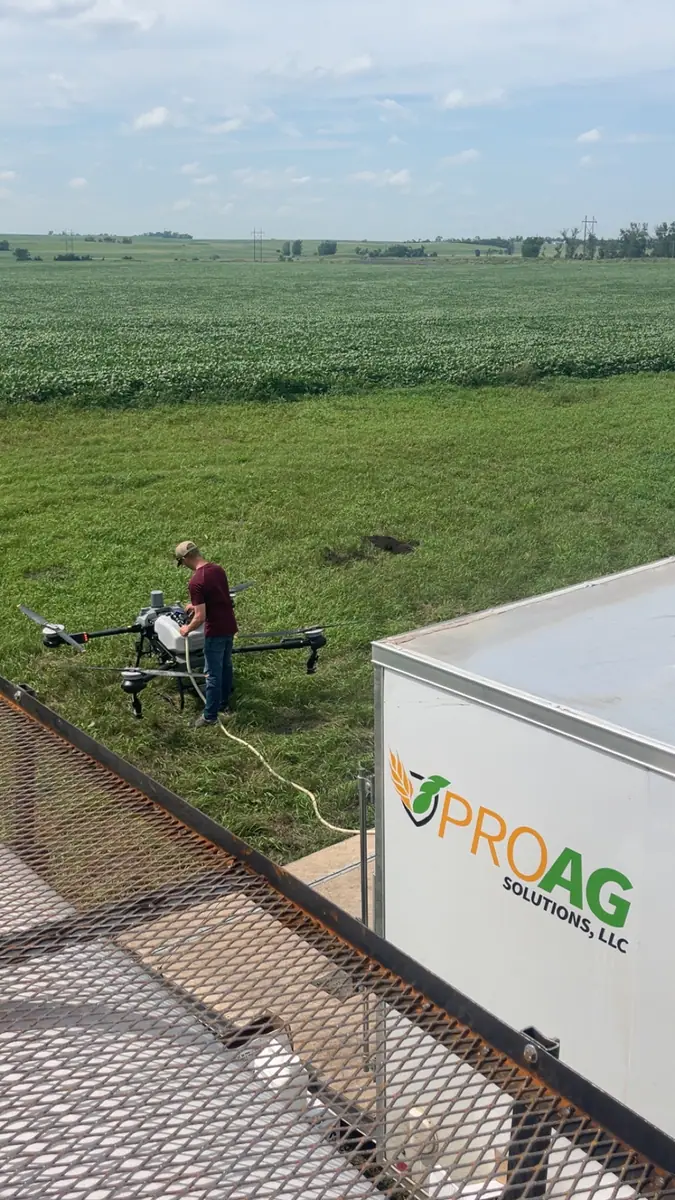
Pro Ag Solutions was founded in 2021 by Cory Palm. Cory has an Associates Degree in Ag Aviation, then worked as an Agronomist for 20 years before stepping back into aerial application using drones. Starting with just a trailer and a DJI T30, Pro Ag Solutions has grown into a full fleet of drones and support vehicles. Licensed in ND, MN, SD. Services include row crop spraying, pasture spraying, CRP, aquatic and right-of-way spraying, multispectral imaging and mapping, soil sampling, cover crop spreading, seed spreading and fertilizer spreading. Team of 6 Part 107 pilots and 4 ground operations personnel.
Verified OperatorFAA Part 137 โ
Drone SprayingFertilizer ApplicationCover Crop Seeding+3 more
3 operators in our directory list crop health monitoring as a service in North Dakota. Use the operator grid below to compare credentials, fleet, response time and pricing before reaching out.
Commercial crop health monitoring in North Dakota requires three credentials: an FAA Part 107 Remote Pilot Certificate for the pilot, an FAA Part 137 Agricultural Aircraft Operator Certificate for the business, and Unmanned Aerial Applicator License (separate from manned aerial) from ND Aeronautics Commission + NDSU Extension. Confirm any operator you hire holds all three before any application.
Most North Dakota operators book 4 to 6 weeks ahead of peak windows; pricing confirmation is contract-bound and operator-specific. In North Dakota, crop health monitoring is most often booked for wheat, corn and soybeans, each with its own seasonal window. For one-off jobs during peak demand spikes, supply tightens fast โ establishing the operator relationship in the off-season pays off.
NDVI (Normalized Difference Vegetation Index) measures the ratio of near-infrared to red light reflected by plants. Healthy plants reflect high near-infrared and absorb red, so high NDVI means healthy dense biomass. Low NDVI zones flag areas with stress, poor emergence, disease or nitrogen deficiency, all of which a drone sensor picks up 1 to 2 weeks before a ground scout would see symptoms.
University trials in Illinois and Iowa show targeted variable-rate nitrogen based on drone NDRE data saves $8 to $15 per acre on fertilizer without yield loss. Fungicide-only treatment of hotspot disease zones rather than whole-field applications saves another $4 to $8 per acre on applicable fields. For most corn and wheat operations, one or two targeted in-season applications based on drone data covers the full seasonal monitoring cost.
Biweekly from V6 through R3 on corn, weekly from R1 through R5 on soybeans, biweekly from tillering through T3 on wheat. Vegetable and specialty crop growers often run weekly missions during the main growing window. Fewer flights miss the inflection points, more flights add cost without much additional signal.
No. Monitoring dispenses nothing, so Part 107 is sufficient. This is why monitoring is often the first ag drone service new operators offer commercially. BVLOS (beyond visual line of sight) flights for whole-farm efficiency require an additional FAA waiver, which is approved case by case and is still the exception rather than the rule in 2026.
NDVI saturates on dense corn canopies after V10, meaning the signal flattens and stress differences become invisible. NDRE uses the red edge band and keeps differentiating even in mature canopies. Corn monitoring should use NDRE from V10 onward, and NDVI is still valid for early vegetative stages and for crops with less dense canopy.