Aerial application of fungicides, insecticides and herbicides by agricultural drone across row crops, vineyards and orchards in all 50 US states.
Drone Pesticide Spraying drone services in South Dakota are listed by 18 operators in this directory. South Dakota's state-level custom-rate guidance averages $12 to $16/acre, with the broader drone pesticide spraying band running $12 to $22/acre. In South Dakota, drone pesticide spraying most commonly serves corn, wheat and soybeans. South Dakota sits in the Great Plains region, which shapes the calendar, weather and competitive pressure local operators plan around. Commercial drone applications in South Dakota require Category 17: Aerial Application (General + Category G + Category 17) from South Dakota DANR on top of FAA Part 137 certification.
Drone Pesticide Spraying — quick facts
Drone pesticide spraying in the US costs $12 to $22 per acre depending on crop, region and product. It is legally required to hold FAA Part 137 certification plus a state commercial pesticide applicator license with aerial category endorsement. Most commercial operators run DJI Agras T50 or Hylio AG-272 class drones at 2 to 5 gallons per acre carrier volume, treating 40 to 60 acres per flight hour per drone.
💧
How drone pesticide spraying works
Drone pesticide spraying is the single largest ag drone service in the United States, generating an estimated 60 percent of all commercial drone flight hours in agriculture. Operators run DJI Agras T50 and T40, Hylio AG-272 and AG-230 and XAG P100 Pro class machines to apply EPA-registered crop protection products at 2 to 5 gallons per acre carrier volume. Typical field throughput is 40 to 60 acres per flight hour for a single T50, and large operators run 3 to 8 drone fleets that treat 800 to 1,500 acres per day during peak windows. The three regulatory pillars every commercial drone sprayer must clear are FAA Part 107 (remote pilot certification), FAA Part 137 (agricultural aircraft operator certificate) and a state commercial pesticide applicator license with an aerial endorsement. Labels govern everything: carrier volume minimums, droplet size specs, wind limits, buffer zones, REI (restricted entry interval) and PHI (preharvest interval) all come from the EPA-approved product label, not from operator preference.
Typical rate: $12 to $22/acre
Drone Pesticide Spraying on top South Dakota crops
In South Dakota, drone pesticide spraying is most commonly used on:
Prices reflect 2026 industry-typical drone spraying rates by crop. Pair with the operator-stated rates below for a quote tailored to your fields.
Aerial pesticide licensing in South Dakota
South Dakota requires Category 17: Aerial Application (General + Category G + Category 17) for aerial pesticide application. The licensing authority is South Dakota DANR.
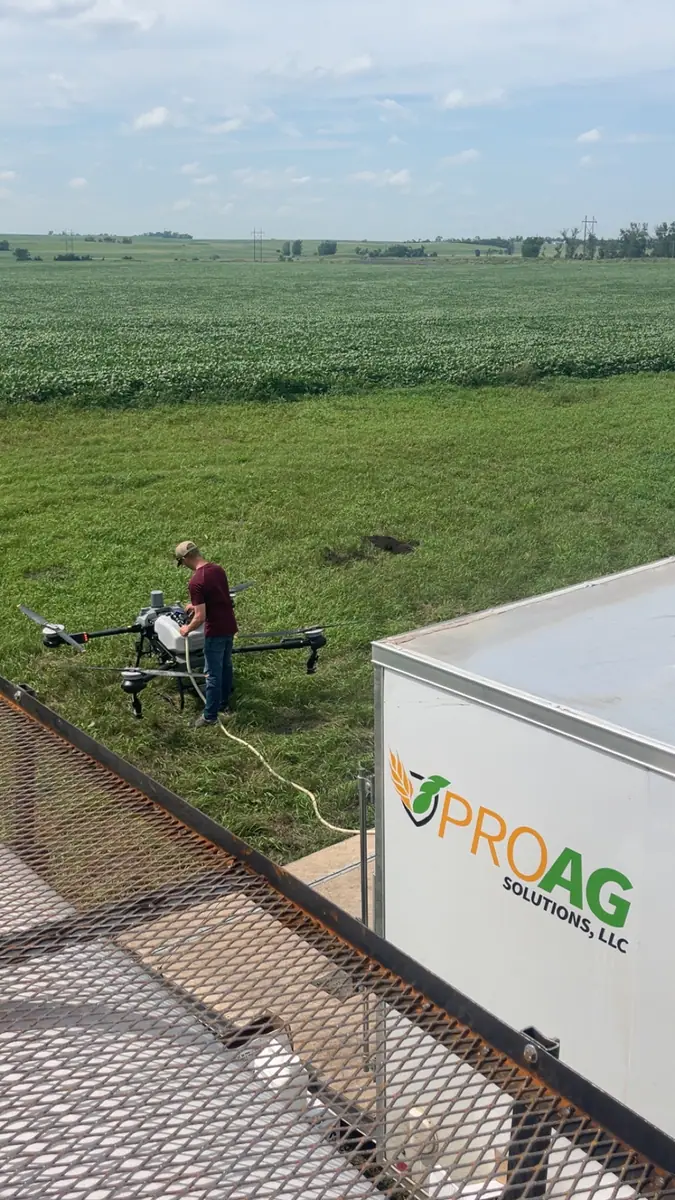
Pro Ag Solutions was founded in 2021 by Cory Palm. Cory has an Associates Degree in Ag Aviation, then worked as an Agronomist for 20 years before stepping back into aerial application using drones. Starting with just a trailer and a DJI T30, Pro Ag Solutions has grown into a full fleet of drones and support vehicles. Licensed in ND, MN, SD. Services include row crop spraying, pasture spraying, CRP, aquatic and right-of-way spraying, multispectral imaging and mapping, soil sampling, cover crop spreading, seed spreading and fertilizer spreading. Team of 6 Part 107 pilots and 4 ground operations personnel.
Operator states: FAA Part 137
Drone SprayingFertilizer ApplicationCover Crop Seeding+3 more
Specializes in custom-built spray drone trailers and precision aerial application. One of the first companies in the region to bring precision drone spraying to agriculture.
Started with three DJI Agras T30 drones in December 2021. Offers equipment sales setup consulting and compliance assistance. Sprayed tens of thousands of acres.
18 operators in our directory list drone pesticide spraying as a service in South Dakota. Use the operator grid below to compare credentials, fleet, response time and pricing before reaching out.
Commercial drone pesticide spraying in South Dakota requires three credentials: an FAA Part 107 Remote Pilot Certificate for the pilot, an FAA Part 137 Agricultural Aircraft Operator Certificate for the business, and Category 17: Aerial Application (General + Category G + Category 17) from South Dakota DANR. Confirm any operator you hire holds all three before any application.
Most South Dakota operators book 4 to 6 weeks ahead of peak windows; rate confirmation is contract-bound and operator-specific. In South Dakota, drone pesticide spraying is most often booked for corn, wheat and soybeans, each with its own seasonal window. For one-off jobs during peak demand spikes, supply tightens fast, establishing the operator relationship in the off-season pays off.
Yes. Any commercial aerial application of pesticides, even by drone, requires a Part 137 Agricultural Aircraft Operator Certificate in addition to Part 107. Farmers spraying only their own crops may qualify for a simplified Part 137 private applicator path, but anyone charging a third party or treating land they do not own must hold the full commercial Part 137.
National averages run $12 to $18 per acre for fungicide and insecticide applications on corn, soybeans and wheat. Orchard, vineyard and specialty crop work runs $18 to $35 per acre because of dense canopy and more passes per season. Minimum field size is typically 40 to 80 acres, with travel surcharges on fields more than 30 miles from the operator base.
Yes, if the product label permits aerial application and the operator holds a state commercial applicator license in the restricted use category. Dicamba has state-specific drone approval rules, paraquat requires an online certification plus state license and 2,4-D drone applications follow the label droplet and wind restrictions. Always check the label and your state department of agriculture before booking.
Most commercial operators cap wind at 10 mph for standard droplet applications and 7 mph for dicamba and 2,4-D. Inversions, rain within 4 to 8 hours and temperatures above 85 F with low humidity also pause spraying. Operators use on-drone weather stations plus local mesonet data to document conditions for every application as required by FIFRA recordkeeping.
For corn fungicide in July, book 4 to 6 weeks out. For wheat heading sprays, book in April for June applications. For orchard and vineyard full-season programs, book an annual contract in January or February. One-off jobs during peak disease or pest spikes are often impossible to source without a pre-existing operator relationship.