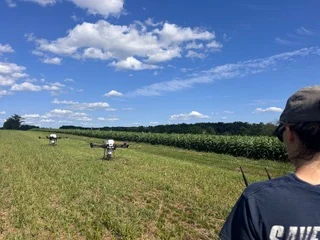
Pasture and rangeland covers approximately 650 million acres in the United States per USDA NASS, the largest single ag land-use category. Drone spraying on pasture costs $14 to $25 per acre, primarily for broadleaf weed control, brush and mesquite knockdown, and seed or fertilizer broadcast. Drones win on terrain where ground rigs cannot operate โ ridges, wooded transition zones, and rocky or hilly grazing land.
Pasture and rangeland covers more than 650 million acres in the United States per USDA NASS. Drone spraying is dominated by broadleaf weed control, brush and mesquite knockdown, and fertilizer or seed broadcast on grazing land too rough for ground rigs.
ULV rate: 2 to 8 gpa
Key pests and diseases
โ Mesquite (Prosopis spp.)
โ Eastern Red Cedar
โ Multiflora Rose
โ Musk Thistle, Canada Thistle, Bull Thistle
โ Prickly Pear Cactus
โ Sericea Lespedeza
Drone application can respond quickly to any of these threats, even in fields with difficult access.
The typical rate for drone spraying on pasture and rangeland is $14 to $25 per acre for application only, the farmer supplies the chemical product. Pricing varies based on total acreage, distance from the operator's base and product type. Larger fields (500+ acres) often qualify for lower per-acre rates.
Optimal timing for drone applications on pasture and rangeland is: Apr, May, Jun, Jul, Aug, Sep. Applications should be made at low wind speeds (under 10 mph), ideally early morning or evening, to maximize product adhesion and minimize drift.
Key advantages of drone application over ground equipment: (1) zero soil compaction, (2) can operate when fields are too wet for tractors, (3) high-precision GPS coverage with 95%+ uniformity, (4) can treat irregular or small fragmented fields and (5) can spray tall crops like corn at full canopy. The main trade-off is a smaller tank size compared to pull-behind ground rigs.